
- Home
- Authenticity
- Origin
- Style
- 1940-1960 (173)
- Antique (89)
- Antiquity (221)
- Antiquité (301)
- Directoire (33)
- Louis Philippe (71)
- Louis Xiii (40)
- Louis Xiv, Baroque (132)
- Louis Xvi (95)
- Middle Ages (23)
- Moyen-âge (61)
- Napoleon Iii (283)
- Napoleon, Empire (43)
- Napoléon Iii (423)
- Napoléon, Empire (75)
- Ottoman (56)
- Renaissance (113)
- Restauration (32)
- 1900 (30)
- 1970 (36)
- Other (3198)
- Sub-type
- Subtype
- Type
Rare Ancient Japanese Sculpture Stone Wise Immortal Turtle Longevity 19th-20th Century
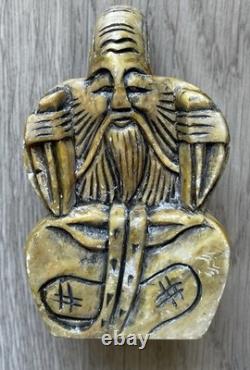
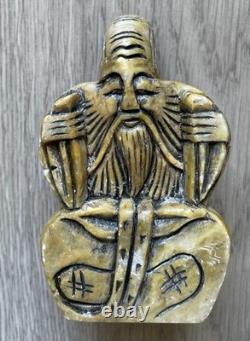
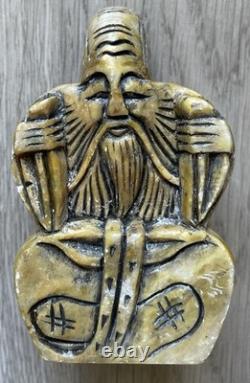


Turtle and Immortal Sage in carved stone. A symbol of strength, longevity, and eternal stability.
A turtle carrying an immortal sage (or linked to the Isles of the Immortals) — a motif shared by China and Japan. Probably late 19th century to mid-20th century.
Here is a superb stone sculpture depicting a turtle. Symbolically, it represents a longevity turtle (tsurukame).
It stands for extreme longevity, wisdom accumulated with age, stability, and protection.
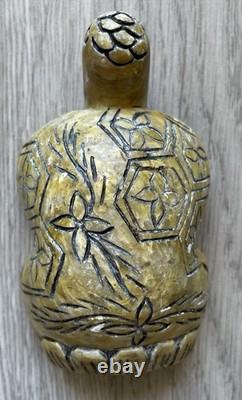
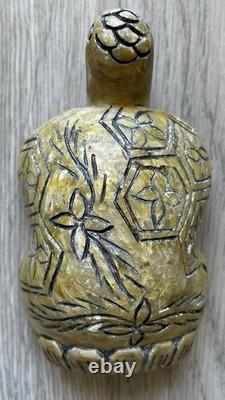
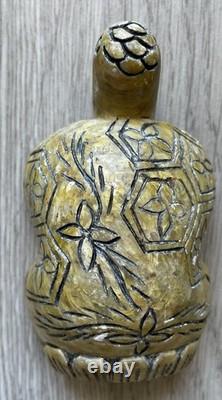
Description of the motifs on the shell:
Hexagonal patterns (kikko in Japanese, the classic tortoise-shell motif in East Asia).
Stylized flowers (resembling chrysanthemums, lotus flowers, or five-petaled blossoms).
Leaves or branches engraved with incised black lines.
What the chrysanthemum motifs represent:
In Japanese culture, and more broadly in East Asian culture, the chrysanthemum is a very powerful and positive symbol.
Longevity and immortality — It blooms late in autumn and withstands the cold, evoking resilience and long life (often associated with the turtle, which is said to live “10,000 years” according to legend).
Nobility and dignity — It is the imperial flower of Japan (the Imperial Family’s seal is a 16-petal chrysanthemum).
It represents perfection, purity, and refinement.
Renewal and joy — A symbol of autumn, fleeting yet enduring beauty, and good fortune.
Association with the turtle:
The combination of turtle + chrysanthemum reinforces the theme of happy longevity.
The stone has a beautiful yellow/orange patina with natural veining, and the engravings are darkened to create contrast. The presence of flowers on the back enhances the decorative and auspicious character, highly appreciated in Japanese and Sino-Japanese folk art of the 19th–20th century.
Analysis of visible details:
Rounded body, raised head (typical of stylized representations), folded legs. The turtle + immortality/longevity symbol is deeply rooted in both traditions, but the turtle carrying a stele or immortal is typically of Chinese origin.
Very strong, thanks to ancient Chinese cultural influence. Such stone turtles are often seen in temples or gardens, sometimes with an immortal or as a monument base. In Japan, one often finds Minogame turtles (“cloak turtle”) or longevity turtles in decorative art. Their shells are often decorated with hexagonal patterns, plants, stylized seaweed, or flowers. These motifs evoke the passing of time, wisdom, and immortality (the turtle lives 10,000 years in mythology).
Small carved or engraved stone figurines in this decorative style (flowers + hexagons) are common in Japanese art objects (netsuke, okimono, garden lanterns, or simple decorative pieces). They are also seen in Zen gardens in the form of “kame-ishi” (turtle stones). Often placed in a home, on a desk, in a garden, or on an altar to bring health and lasting good fortune.
Size: height: 2.5 cm.
Size: length: 8.3 cm.
Photos to be consulted in the listing.